SUMMER LIFE
Saving time
South Africa (iafrica.com)
Johannesburg / Cape Town
by Lucille Parker
08 Jan 2002
“If only there were more hours in a day,” is the anguished cry of many a stressed out worker! Of course we are rigidly controlled by the 24-hour clock, and we can’t change the passing of time: what we can do, however, is manipulate the hours we do have to make better use of them – particularly in summer.
This morning I started work at 8am in Cape Town, with a hot sun already fairly high above the mountains, ready to blaze through another blissful day whilst I slave away in a dark corner. How much more sensible it would be, I thought, if I started work at dawn (or before), worked my stint, and then emerged in the late afternoon into “the remains of the day” to look forward to at least another five hours of sunshine.
My local newspaper weather section tells me that the sun rose today at 05h40 – at which time I was fast asleep! Before I had awakened, showered and breakfasted, then set off for work at about 07h40, I had missed out on two hours of daylight! Seems to me I would have been better off doing my ablutions in darkness, and tacking those two hours on to my summer evening instead, when I could have sunbathed during what is currently the evening cocktail hour!
This could be simply achieved – all we have to do is turn our clocks forward an hour (or two, or whatever the “fundis” deem fit) at the beginning of summer, and turn them back again on the appropriate date at the end of the season. Our neighbour Namibia does it – why can’t we?
The idea itself is certainly nothing new: it was first mooted by Benjamin Franklin (former US President) in an essay he wrote in 1784. Franklin’s advocacy of “daylight saving” was economically based – he thought it a great energy saving idea, conserving light and heat.
A century or so later in Britain a builder published a pamphlet proposing advancing the clocks in summer: William Willett lamented the fact that “the clear, bright light of an early morning during spring and summer months is so seldom seen or used”.
It took awhile for the idea to catch on – early proponents of “daylight saving” were generally ridiculed – but a year after Willett died (in 1915) his idea was adopted by the British Parliament who passed legislation introducing Daylight Saving Time (DST) in May, 1916: henceforth clocks were to be put one hour ahead of Greenwich Mean Time (GMT) during the summer months. The main motivation was energy saving, particularly in the face of world war – in fact in World War II in Britain DST was extended to “grab” an extra two hours of daylight in summer, and one hour in winter.
DST, or “summer time”, caught on internationally in record time as countries realised the benefits of making better use of daylight. Apart from keeping people more active in the light evenings, the energy saving cannot be disputed - studies conducted by the US Department of Transportation show that DST “trims the entire country’s electricity usage by a significant, but small amount, of less than one percent each day”. This is because energy use and demand is “directly connected to when we go to bed and when we get up” – simply, when it is dark outside we put on the lights and turn on the TV!
In South Africa there could be another benefit too – light, bright evenings would mean safe evenings. Criminals would find it more difficult to “hide” their nefarious activities in extended evening light, and improved visibility for road-users would probably mean fewer accidents occuring in the evening hours (studies in the US and Britain have found that DST decreases by four times the likelihood of pedestrians being killed on the roads).
On the down side of course, there is the confusion and inconvenience of changing clocks and adjusting your “biological” sleep schedule. This may cause temporary temporal problems – but is a small price to pay for an extra hour or two of “daytime” in my opinion.
DST has been standardised across the European Union, and is utilised in most (but not all) US States. In Africa only Egypt and Namibia use DST. Of course in central Africa – and anywhere on the lower latitudes – DST is not necessary because there is little seasonal variation in daylight hours; but I reckon that South Africa – particularly the Western Cape – is far enough south to benefit from a little extra light!
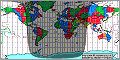
Click here www.worldtimezone.com/daylight.html
for a world map showing which countries (depicted in yellow) utilise DST.
|